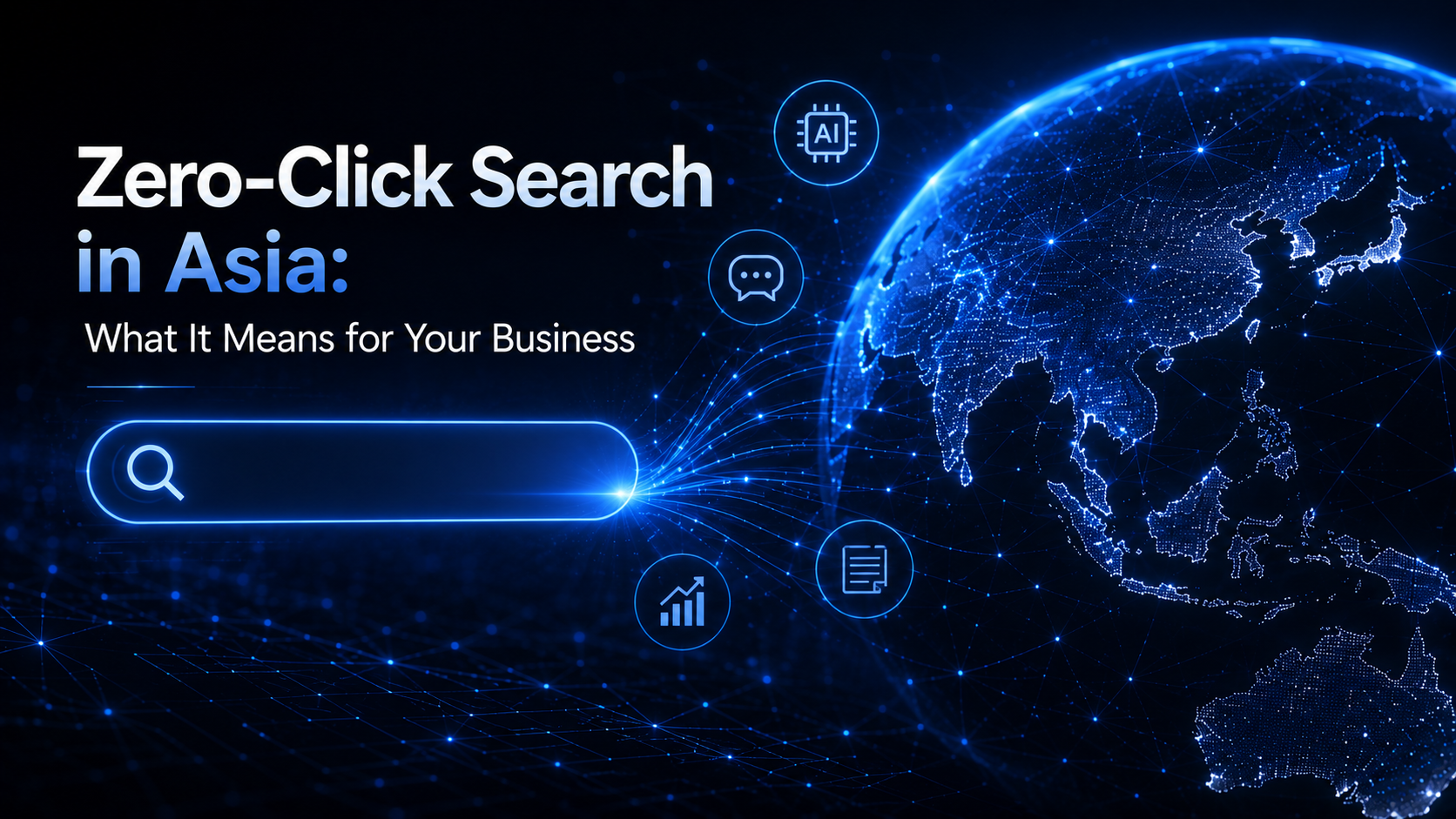
More than 60% of searches across Asia now end without a single click to any website. Your brand could be ranking on page one — and still be completely invisible. Here is what is happening, why it matters more in Asia than anywhere else, and what to do about it.
60%+ of all Google searches end with zero clicks globally (2025–2026)
61% drop in organic CTR for queries with AI Overviews across APAC
73% of ranking brands in Asia get zero mentions inside AI Overviews
8 APAC markets where Google AI Overviews are now live, incl. Malaysia & Singapore
The Quiet Revolution in How Asia Searches
Not long ago, the goal of SEO was simple: rank as high as possible so users would click your link. That logic is now broken — and it is breaking faster in Asia than almost anywhere else in the world.
A zero-click search occurs when Google — or any AI-powered search engine — answers a user’s question directly on the results page. Featured snippets, knowledge panels, AI-generated summaries, local packs, weather widgets, calculator tools: all of these deliver the answer before the user ever needs to visit your website.
By early 2025, this had moved from a niche concern to the dominant reality of search. Around 60% of all global searches now result in no external click. On mobile — which accounts for the majority of searches across Southeast Asia — that figure climbs to 77%.
Why Asia Faces a Steeper Challenge
Globally, zero-click is accelerating. But for brands operating in Southeast Asia, the stakes are higher — and the shift is already underway.
Google has already rolled out AI Overviews across eight APAC markets, including Malaysia, Singapore, Indonesia, India, and the Philippines. Commercial intent queries — the searches that matter most for businesses, the ones where buyers are comparing options or looking for solutions — saw AI Overview appearances more than double between 2024 and 2026, growing from 8.15% to 18.57%.
The consequence is stark: organic click-through rates for queries with AI Overviews dropped 61% between mid-2024 and late 2025. And despite 73% of regionally-ranking brands appearing in traditional search results, they receive zero mentions inside AI-generated answers.
Southeast Asia’s digital landscape adds further complexity. The region has one of the youngest, most mobile-first populations on the planet. In Singapore, 78% of social media users use Google Search to validate discoveries made on social platforms — meaning search acts as the trust layer between social browsing and real-world purchasing decisions. For these users, an AI summary that confirms or dismisses a brand is often the last word.
The Three Types of Zero-Click That Are Affecting Your Brand
Understanding which zero-click formats are eating your visibility is the first step toward reclaiming it.
AI Overviews & AI Mode
Google synthesises answers from multiple sources into a single AI-generated response at the top of the page. If your brand is not cited as a source, you are invisible — even if you rank in position 1 below it.
Featured Snippets
Google extracts a direct answer — a definition, a list, a step-by-step guide — from a single webpage and displays it prominently. The originating site sees brand visibility, but reduced click incentive for the casual reader.
Knowledge Panels & Local Packs
For local-intent and navigational queries — “branding agency Kuala Lumpur”, “coffee shop near KLCC” — Google displays business info directly. Up to 78% of local-intent searches end without a click to an external website.
People Also Ask (PAA)
65% of all Google SERPs now include a PAA box. While only 3% of total SERP clicks go to PAA results, 40% of users open at least one question — making PAA a critical brand-awareness surface even without a click.
From SEO to GEO: The Strategic Shift Your Brand Needs
Traditional SEO optimised for algorithms that rank pages. The new discipline — Generative Engine Optimisation (GEO) — optimises for AI systems that synthesise answers. The goal is no longer just to rank; it is to be cited, referenced, and trusted as a source by the AI itself.
This is also called Answer Engine Optimisation (AEO): structuring your content and authority signals so that AI-powered search engines — Google AI Overviews, ChatGPT Search, Perplexity, and emerging regional players — include your brand when generating responses.
5 Things Asian Businesses Must Do Right Now
1. Optimise for Featured Snippets and AI Overviews
Restructure your key content pages to directly answer the questions your audience is asking. Use clear headings, concise definitions, numbered steps, and comparison tables. Implement FAQ schema and HowTo schema markup — structured data helps AI systems identify and extract your answers. Businesses that implemented comprehensive structured data strategies reported a 22% increase in brand impressions and a 16% rise in assisted conversions even as direct traffic declined.
2. Build Genuine Topical Authority
AI systems favour sources that demonstrate deep, consistent expertise on a subject. Rather than producing broad content across many topics, invest in pillar content — comprehensive, authoritative guides on the specific areas where your brand should own the conversation. A branding agency should be the definitive source on brand strategy in Southeast Asia. A logistics company should own “supply chain visibility in Malaysia.” Depth beats breadth in the AI citation economy.
3. Treat Your Google Business Profile as a Brand Asset
For local and regional intent searches — which drive up to 78% zero-click outcomes — your Google Business Profile (GBP) is the primary surface where customers will encounter your brand. Ensure all details are accurate and consistent across every platform (name, address, phone, hours). Add high-quality photos regularly. Respond to reviews and questions. Publish timely posts. A well-maintained GBP functions as a micro-website within Google itself.
4. Invest in Digital PR for AI Citations
AI Overviews pull their answers from sources they deem credible and authoritative. Industry publications, news outlets, research reports, and well-respected blogs are disproportionately cited. Getting your brand — and your leadership — mentioned and quoted in these sources is no longer just good for traditional SEO; it directly increases the probability that AI systems will reference your brand when answering relevant queries. Digital PR is now a GEO strategy.
5. Redefine How You Measure Success
If your reporting still centres exclusively on organic traffic and click-through rates, you are measuring a world that no longer exists. Start tracking SERP feature impressions (available in Google Search Console), branded search volume, AI citation monitoring tools, and share of voice against competitors. Measure brand searches and direct traffic as proxies for zero-click brand exposure doing its job. The goal has shifted from traffic to trusted presence.
Restructure your key content pages to directly answer the questions your audience is asking. Use clear headings, concise definitions, numbered steps, and comparison tables. Implement FAQ schema and HowTo schema markup — structured data helps AI systems identify and extract your answers. Businesses that implemented comprehensive structured data strategies reported a 22% increase in brand impressions and a 16% rise in assisted conversions even as direct traffic declined.
Audit your top 20 target keywords and check whether AI Overviews now appear for them
- Add FAQ schema to your service pages and FAQ content immediately
- Review and complete your Google Business Profile across all locations
- Identify three to five topics where your brand can credibly claim deep authority
- Establish a digital PR programme targeting APAC industry publications and Google-indexed media
- Set up SERP feature tracking in Google Search Console and a brand-mention monitoring tool
What Zero-Click Search Means for Branding Specifically
Zero-click search is not just an SEO problem — it is a branding problem. When AI answers a question about your industry, category, or product area without naming your brand, you have effectively been excluded from the consideration set before the customer even begins their journey. Awareness happens on the SERP. Evaluation happens on the SERP. In many cases, intent is confirmed or abandoned on the SERP.
This means that brand building and search strategy must now be the same strategy. A strong, authoritative brand presence — built on genuine expertise, consistent messaging, digital PR, and structured content — is not just good for reputation. It is the core mechanism by which you earn AI citations and SERP visibility.
For brands operating across Southeast Asia’s diverse markets, this means developing content and authority signals that resonate locally — in language, in cultural context, in the specific questions your Malaysian, Singaporean, Indonesian, or Filipino audience is actually typing into search.
Serah Siew
Founder & Creative Director · HummingDe Consultancy
Serah Siew is a Creative Director, brand strategist, and contemporary artist based in Malaysia. She is the founder of HummingDe Consultancy, specialising in AI authority branding and Generative Engine Optimization (GEO) for businesses in Malaysia and Singapore.
About the Author →