HummingDe Insights, Written by Serah Siew — Branding for the AI Era ·
What Is GEO —And Why Asian Businesses Must Care Now
AI is no longer just answering questions. It is deciding which brands exist. Generative Engine Optimization (GEO) determines whether your business is cited, recommended — or completely invisible inside the new AI-first web.
Not long ago, a client and close friend sat down with me over coffee. She was glowing — and rightfully so. “Google my name,” she said, sliding her phone across the table. “A whole page. All me.” It was impressive. She had put in the work, and it showed.
Then I asked her the question I ask every client sooner or later. “That’s great,” I said. “But what if I open ChatGPT right now and search for the best industry leader in your space — will your name come up?”
She went quiet. We both knew the answer. Because the AI replies instantly — naming three or four brands with confident, authoritative language. Her name was not among them. She had a beautiful website. She ranked on Google. But in the AI’s answer, she simply did not exist.
This is the new competitive frontier. And the discipline that determines whether you appear — or disappear — inside AI-generated answers is called Generative Engine Optimization, or GEO.
58% of consumers now use AI tools for brand discovery & research
3× faster growth of AI-assisted search vs traditional search in Asia-Pacific
2026 year AI-generated answers are expected to surpass click-based results
What Is GEO — Generative Engine Optimization?
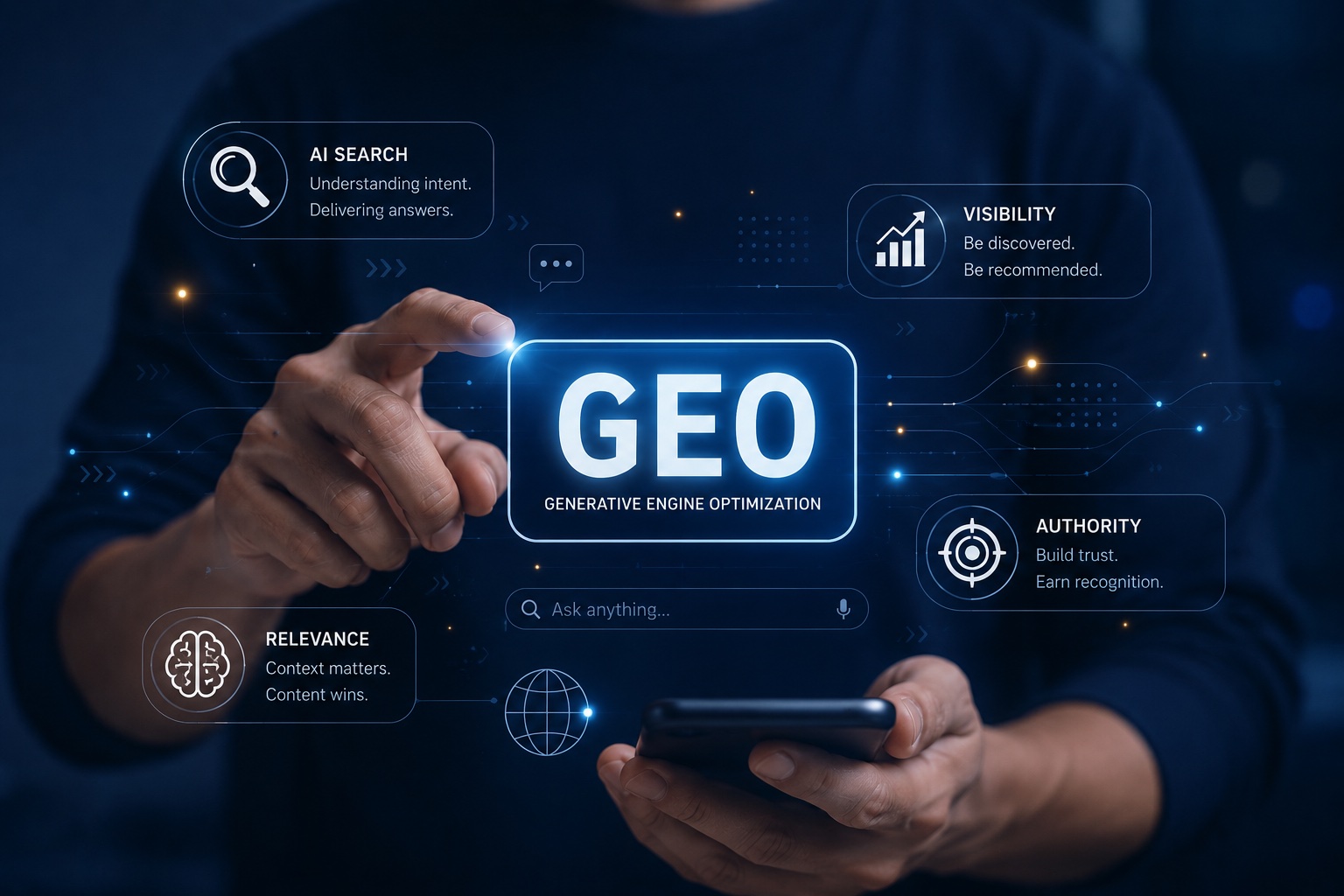
GEO is the practice of optimizing your brand’s digital presence so that AI language models — ChatGPT, Perplexity AI, Google Gemini, Microsoft Copilot, and their successors — accurately cite, recommend, and represent your brand when answering relevant queries.
Where traditional SEO is about ranking in a list of blue links, GEO is about becoming the source an AI draws from when it constructs a direct, synthesized answer. The AI does not show ten results and let users click. It forms an opinion. It names names. It builds a narrative. And that narrative is shaped by the signals it has absorbed about your brand across the entire web.
“SEO got you found. GEO determines whether you are trusted enough to be spoken about — by a machine — to millions of people who may never visit your website at all.”— Hummingde Brand Strategy, 2025
GEO is not a replacement for SEO. It is the next layer. A brand that has strong GEO presence is one that AI models treat as an authoritative, trustworthy, well-defined entity — worthy of citation in their responses.
SEO vs. GEO: Understanding the Shift
The difference is not just technical. It is philosophical. SEO optimizes for algorithms that rank. GEO optimizes for AI models that reason.
| Dimension | Traditional SEO | GEO New |
|---|---|---|
| Goal | Rank on search results page | Be cited inside AI-generated answer |
| Output | A clickable link in a list | A brand mention in a synthesized response |
| Key signals | Backlinks, keywords, page speed | Entity authority, citations, structured data, brand clarity |
| User action | User clicks a link | User reads AI answer — may never visit your site |
| Content style | Keyword-dense, long-form | Clear, quotable, definitively structured |
| Trust signals | Domain authority, PageRank | Entity consistency, third-party mentions, factual accuracy |
| Speed of impact | Months to years | Compound — starts immediately, grows with AI adoption |
Why This Matters Urgently for Asian Businesses
Asia is not behind on AI adoption — it is, in many markets, ahead. Consumers in Malaysia, Singapore, Indonesia, Thailand, Vietnam, and the Philippines are integrating AI assistants into daily decisions at extraordinary rates. The combination of mobile-first behaviour, high digital literacy, and rapidly growing middle classes creates a uniquely high-stakes environment for brand discoverability.
Yet most Asian brands — including well-funded ones — have built their digital presence almost entirely around traditional SEO and social media. Their content is not structured for AI citation. Their brand entity data is inconsistent across platforms. Their credibility signals are concentrated in channels that AI models weight lightly.
The Invisible Brand Problem
An AI model forms its “opinion” of your brand from thousands of data points scattered across the web — news articles, directories, reviews, social profiles, structured data, third-party citations. If those signals are absent, inconsistent, or weak, the AI will either ignore your brand entirely or misrepresent it. For brands in competitive Asian markets, this is not a future risk. It is already happening.
Consider the buyer journey of a mid-sized Malaysian company evaluating enterprise software vendors, or a Singaporean investor researching wealth management firms. They do not start with Google anymore. They start with a conversation with AI. If your brand is not in that conversation, you are not in their consideration set.
This is not theoretical. Research from Princeton, Georgia Tech, and independent practitioners in 2024 confirmed that GEO-optimized content receives significantly more citations in AI-generated responses than content that has only been optimized for traditional search.
How AI Models Decide Which Brands to Mention
Understanding GEO requires understanding how large language models build their world model. These models are not crawling the web in real time (with some exceptions like Perplexity). They are drawing on patterns learned during training — patterns about which entities are consistently described, factually referenced, and positively associated with particular domains.
The signals that build AI brand authority fall into several categories:
- Entity clarity — Does the AI have a clean, consistent understanding of what your brand is, does, and stands for? Inconsistent naming, vague positioning, and conflicting descriptions cause AI confusion and suppression.
- Citation density — How many credible third-party sources mention your brand in factual, authoritative contexts? News coverage, analyst reports, awards, partnerships, and case studies all count.
- Structured data signals — Schema markup, Knowledge Panel data, Wikipedia or Wikidata presence, and consistent NAP (name, address, phone) data across directories help AI models form accurate entity maps.
- Content quotability — Content that contains clear definitions, direct answers to specific questions, and well-attributed statistics is far more likely to be used as a source in AI synthesis.
- Semantic authority — Does your content comprehensively and accurately cover a topic domain? AI models reward depth and topical expertise over keyword repetition.
- Recency and freshness — Real-time AI systems like Perplexity actively crawl. Regular publication of authoritative, original content keeps your brand in circulation.
The GEO Strategy Framework for Asian Brands
Hummingde has distilled GEO practice into a five-layer framework suited to the specific conditions of Asian markets — where multilingual content, platform fragmentation, and varying AI tool adoption create unique challenges and opportunities.
- Brand Entity Architecture Define and document your brand entity with precision. This means a clear brand description, consistent naming conventions, a well-structured “About” narrative, and presence on authoritative reference databases (Wikipedia, Wikidata, Google Knowledge Graph). AI models learn who you are from these anchor points.
- Authority Content Infrastructure Build content that AI models will want to cite — not just content users will want to read. This means structuring content around direct questions and answers, embedding verifiable statistics, attributing expert voices, and publishing in formats that signal editorial credibility. Thought leadership articles, research reports, and definitive guides perform particularly well.
- Citation & Digital PR Strategy Earn mentions in publications, databases, and platforms that AI models weight as authoritative sources. In Asian markets this means a mix of regional business media (The Edge, Nikkei, Singapore Business Review, KrAsia), global industry publications, and credentialed awards and rankings. Each citation is a vote of confidence that AI models accumulate over time.
- Structured Data & Schema Deployment Implement comprehensive schema markup across your digital properties — Organization schema, Article schema, FAQ schema, Product schema as relevant. This is not just technical hygiene; it is the machine-readable vocabulary that helps AI models classify and represent your brand accurately in generated responses.
- Multilingual GEO for Asian Contexts AI tools used in Asia respond to both English and local-language queries. Brands that maintain authoritative content in Bahasa Malaysia, Mandarin, Thai, Bahasa Indonesia, and Filipino unlock AI visibility across a far wider audience. Content translation is not enough — each language layer requires its own entity and citation strategy.
Is Your Brand Ready for the GEO Era?
The honest answer for most Asian businesses is: not yet. But the gap is closeable — and the brands that move now will build a compounding advantage that latecomers will find very difficult to overcome.
Ask yourself the following questions. They are a fast diagnostic for your current GEO readiness:
- If I ask ChatGPT or Perplexity about my industry category in my market, does my brand appear in the answer?
- Is my brand described consistently across my website, LinkedIn, Google Business Profile, and third-party directories?
- Has my brand been mentioned in credible third-party media in the last 12 months — not just press releases, but genuine editorial coverage?
- Does my website contain content that directly, clearly answers the specific questions my target customers ask AI tools?
- Do I have FAQ schema, Organization schema, or Article schema deployed on my key pages?
- Does authoritative content exist in the languages my customers use with AI tools?
If your answer to most of these is “no” or “unsure,” you are not behind — you are at the starting line of a race that has just begun. The brands investing in GEO now are building the digital authority that AI models will draw on for years to come.
“In five years, the most valuable brand asset in Asia will not be a Google ranking. It will be an AI that mentions your name first — and trusts it.”— Hummingde, 2026
Is Your Brand Invisible to AI?
Get a free GEO audit from Hummingde. We’ll show you exactly how AI sees your brand today — and what it takes to change it.Get Your Free Audit
Work with us →hummingde Brand Strategy & GEO Intelligence
Serah Siew
Founder & Creative Director · HummingDe Consultancy
Serah Siew is a Creative Director, brand strategist, and contemporary artist based in Malaysia. She is the founder of HummingDe Consultancy, specialising in AI authority branding and Generative Engine Optimization (GEO) for businesses in Malaysia and Singapore.
About the Author →