Search has fundamentally changed. AI engines like ChatGPT, Perplexity, and Google AI Overviews are now the new front pages of the internet. Here is what every Asian brand needs to know to stay visible — and authoritative — in both worlds.
Ask yourself this: when your potential customer types “best branding agency in Malaysia” or “skincare brand for humid weather” into ChatGPT or Perplexity — does your brand appear in the answer?
If you have been focused exclusively on ranking on Google Page 1, you may be missing the most important shift in digital discovery since the smartphone. Generative Engine Optimization (GEO) is no longer a future trend — it is happening right now, and Asian brands that act early will build a significant competitive advantage.
This guide breaks down exactly what GEO is, how it differs from traditional SEO, and what Asian brands — whether you are in Malaysia, Singapore, Indonesia, Thailand, or beyond — need to do to win in both arenas.
58% of Gen Z in SEA uses AI chatbots for product research
40% of Google searches now trigger AI Overviews (SGE)
3× higher brand recall when cited by AI vs. a blue link
2025 the year GEO moved from optional to essential
What is GEO — Generative Engine Optimization?
GEO (Generative Engine Optimization) is the practice of optimizing your brand, content, and digital presence so that AI-powered search engines — ChatGPT, Perplexity, Google AI Overviews (SGE), Bing Copilot, and others — cite, reference, and recommend your brand in their generated answers.
Unlike traditional search, where a user clicks through to a list of links, generative engines synthesize information and present a direct answer. Your brand either gets mentioned in that answer — or it does not exist for that user.
GEO is about becoming a trusted source that AI models draw from. This requires a fundamentally different approach: instead of chasing algorithms with keywords, you build genuine authority, credibility, and a consistent, well-documented brand narrative across the web.
What is SEO — and Is It Still Relevant?
SEO (Search Engine Optimization) is the process of optimizing your website and content to rank highly in traditional search engine results pages (SERPs) — primarily Google and Bing. It encompasses technical optimization, keyword targeting, backlink building, and content quality.
SEO remains valuable. Billions of searches still happen on traditional Google daily, and click-through traffic from organic rankings drives real conversions. However, its supremacy as the only digital discovery channel is definitively over.
For Asian brands, this is critical: the consumer journey now frequently begins with an AI query. A potential customer may never see your Google ranking if an AI gives them a synthesized answer before they ever scroll to the blue links.
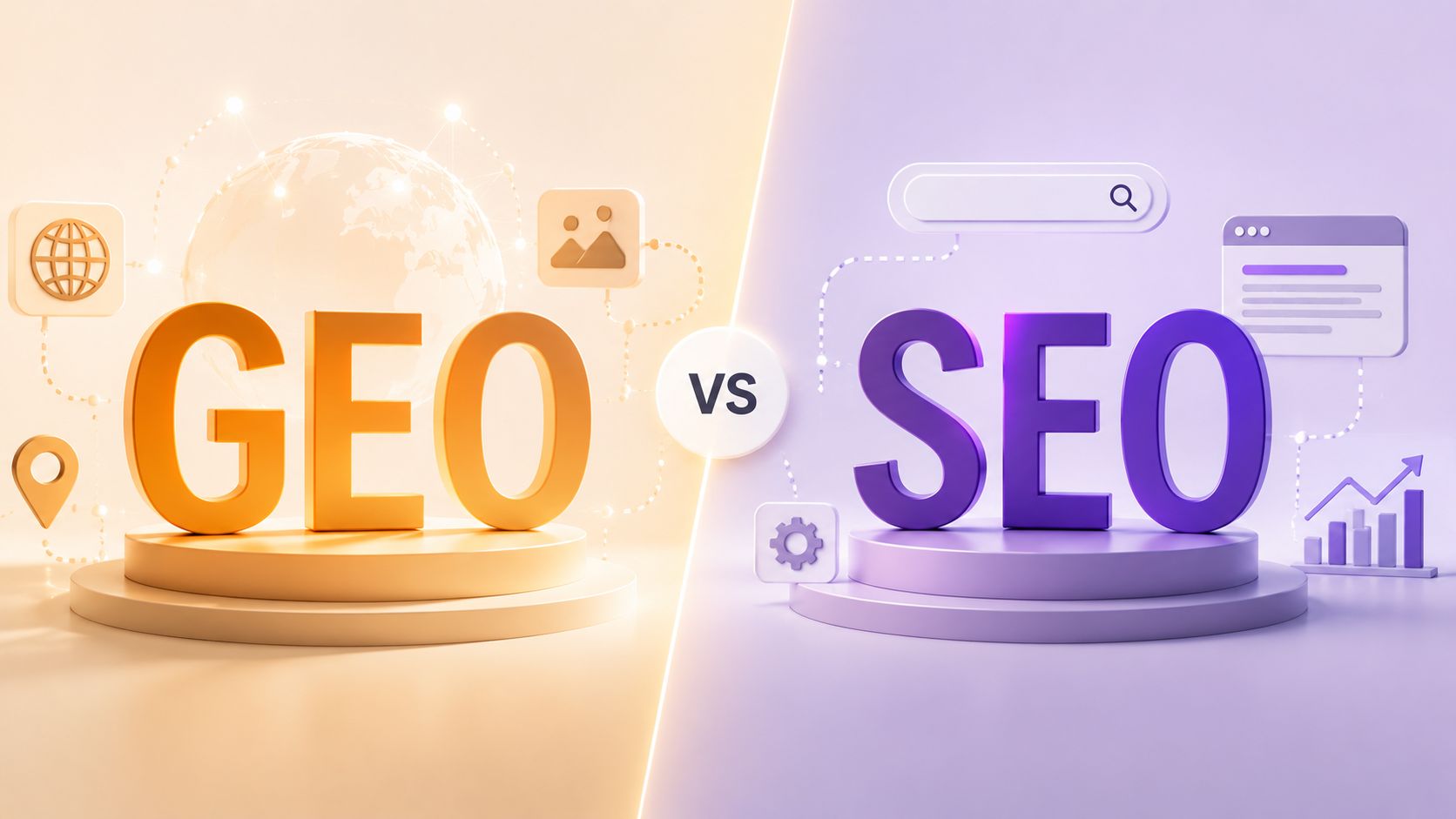
GEO vs SEO: The Key Differences
| Dimension | SEO — Traditional Search | GEO — Generative AI Search |
|---|---|---|
| Primary Goal | Rank on Page 1 of Google/Bing | Be cited in AI-generated answers |
| Key Metric | Rankings, organic traffic, clicks | Brand mentions in AI outputs, share of AI voice |
| Content Strategy | Keyword-optimized pages targeting search intent | Authoritative, fact-rich, citable content |
| Backlinks | Domain authority via link building | Mentions on trusted media, PR, and reference sites |
| User Experience | User clicks a link to visit your site | User receives AI answer — brand recall without clicking |
| Technical Signals | Page speed, Core Web Vitals, mobile, schema | Structured data, clear entity definition, consistent NAP |
| Trust Signals | Backlinks, domain authority, reviews | E-E-A-T, third-party citations, verified author expertise |
| Content Format | Long-form blogs, landing pages | Direct-answer formats, FAQs, structured summaries |
| Time Horizon | 3–6 months for ranking gains | 6–18 months to build AI authority and citations |
| Best Tool | Google Search Console, Ahrefs, Semrush | Brand monitoring, AI mention tracking, PR reach |
Why This Matters Specifically for Asian Brands
Asian brands — particularly those in Southeast Asia, South Korea, Japan, and China — face a unique set of challenges and opportunities in the GEO landscape:
1. Western AI Models Have Knowledge Gaps on Asian Brands
Large language models like GPT-4 were predominantly trained on English-language web content. This means Asian brands are systematically underrepresented in AI training data. If your brand has limited English-language coverage on authoritative sites, AI engines may not know you exist — or worse, may produce inaccurate information about your brand.
2. Multilingual GEO Is a Real Advantage
Brands that create authoritative content in both English and local languages (Bahasa Malaysia/Indonesia, Mandarin, Thai, Tagalog, Vietnamese) have a structural edge. AI engines increasingly process multilingual queries, and being the authoritative source in your language creates a competitive moat.
3. Southeast Asia’s AI Adoption Is Accelerating Fast
According to regional digital reports, Southeast Asia has some of the highest smartphone penetration and AI tool adoption rates globally. Malaysian, Singaporean, and Indonesian consumers — especially Millennials and Gen Z — are heavy users of AI tools for research, shopping decisions, and recommendations. The window to establish GEO authority before competitors is narrowing.
4. Asian Export Brands Need Global AI Visibility
For Asian brands with international ambitions — whether that is a Malaysian F&B brand expanding into the Middle East, a Korean beauty brand entering Europe, or a Taiwanese tech brand entering the US market — GEO determines whether international consumers find you in AI searches. Traditional SEO in a foreign market is slow; AI authority can travel faster.
The 7 GEO Signals That Matter Most for Asian Brands
Based on how leading AI engines source and cite information, these are the signals that drive whether your brand appears in AI-generated answers:
GEO Signal #1
Third-Party Authority Citations
Earn mentions on credible media outlets, industry publications, government databases, and well-respected blogs. AI engines heavily weight information sourced from trusted third parties. A feature in The Edge, Business Times, or Tatler Asia builds AI authority in ways self-publishing cannot.
GEO Signal #2
Entity Definition & Consistency
AI models understand brands as entities. Your brand name, description, founding date, location, products, and people must be stated consistently across your website, Wikipedia, Google Business Profile, social profiles, and press coverage. Inconsistency creates confusion — and AI models resolve confusion by omitting the entity.
GEO Signal #3
E-E-A-T: Experience, Expertise, Authoritativeness, Trust
Google’s E-E-A-T framework, originally for human evaluators, is now a proxy for what AI models value. Content must demonstrate real expertise. Byline your articles with named, qualified authors. Include credentials, case studies, and original data. Asian brands with strong heritage should document it explicitly.
GEO Signal #4
Direct-Answer Content
AI engines are trained to answer questions. Create content that directly answers questions your customers ask: “What is [your product category]?”, “How does [your service] work?”, “Why should I choose [brand type] in Malaysia?” Use FAQ sections, definition blocks, and structured summaries that AI can extract cleanly.
GEO Signal #5
Structured Data Markup
Implement Schema.org structured data: Organization, LocalBusiness, Product, FAQPage, Article, and BreadcrumbList. Schema markup gives AI engines machine-readable context about your brand. It is one of the highest-ROI technical GEO tactics available and still dramatically underused by Asian brands.
GEO Signal #6
Wikipedia & Knowledge Graph Presence
A Wikipedia entry or Wikidata record dramatically increases the likelihood of AI citation. For established Asian brands, this is achievable. Even without Wikipedia, ensure your brand has a Google Knowledge Panel claimed and verified, and that your brand data exists in public knowledge graph sources.
GEO Signal #7
Consistent Content Cadence
AI engines favour brands with a consistent, up-to-date digital presence. Dormant websites signal irrelevance. Publish regularly — even modestly. A monthly in-depth article, a quarterly brand report, or consistent social publishing signals an active, reliable entity to both AI models and their training crawlers.
SEO Still Matters — Here Is Why You Cannot Abandon It
Some voices in the marketing world declare SEO dead. This is wrong. Here is why traditional SEO remains essential for Asian brands:
AI Engines Are Trained on SEO-Optimized Content
Here is the irony: the content that large language models learned from was predominantly SEO-optimized content. High-quality, well-structured, keyword-relevant pages are more likely to have been indexed, crawled, and incorporated into AI training data. Good SEO is foundational GEO infrastructure.
Purchase Intent Still Lives on Traditional Search
When a consumer is ready to buy, they often switch to Google Shopping, Google Maps, or a direct search for price comparison and reviews. Organic rankings and Google Business Profile optimization directly drive conversions that AI-mediated discovery cannot fully replicate yet.
Local Search Is Still Dominated by Traditional SEO
For Asian brands with physical presence — restaurants, retail stores, clinics, hotel properties — local SEO via Google My Business, reviews, and local pack rankings remain primary discovery channels. GEO does not replace these; it complements them.
Your 90-Day GEO + SEO Action Plan for Asian Brands
Here is a practical, phased roadmap to start building both SEO foundations and GEO authority simultaneously:
1. Audit Your Brand Entity (Days 1–7)
Search your brand name in ChatGPT, Perplexity, and Google. Document what AI says about you. Is it accurate? Is your brand even mentioned? Check consistency of your brand name, description, and details across all online touchpoints. Flag every inconsistency — these are GEO vulnerabilities.
2. Build Your Entity Foundation (Days 8–21)
Standardize your brand name, tagline, founding year, headquarters, key products, and leadership across your website, Google Business Profile, LinkedIn, and all social channels. Add comprehensive Organization and LocalBusiness schema markup to your website. Claim your Google Knowledge Panel if not already done.
3. Publish Authoritative Cornerstone Content (Days 14–45)
Create 3–5 in-depth articles on topics where your brand has genuine expertise. Answer the specific questions your target customers ask AI engines. Include direct-answer summaries, FAQ sections, and structured data. Assign named, credentialed authors. Aim for 1,500–3,000 words of genuinely useful, factually rich content.
4. Earn Third-Party Mentions (Days 30–90)
Identify 10–15 credible media, industry, or directory sites relevant to your sector and geography. Pitch guest articles, offer expert commentary for journalists, submit to industry databases and awards. Each quality mention trains AI engines that your brand is a credible entity worth citing. Prioritize English-language outlets for maximum AI training data coverage.
5. Optimize Technical SEO Foundations (Days 15–60)
Conduct a technical SEO audit: fix crawl errors, improve page speed, ensure mobile responsiveness, implement proper heading hierarchy, add alt text to images, and create a clean XML sitemap. These improve your Google rankings and ensure AI training crawlers can accurately index your content.
6. Monitor Your AI Presence (Ongoing)
Set up monthly checks: query ChatGPT, Perplexity, and Google AI Overviews for your key brand terms and relevant industry questions. Track whether your brand appears, and whether the information is accurate. Update and refresh content when AI outputs are incorrect or outdated. AI brand monitoring is now a permanent function of modern brand management.
GEO Readiness Checklist for Asian Brands
Use this checklist to assess your current GEO readiness:
✓AI brand monitoring is included in the monthly marketing review process
✓Brand name, description, and key facts are consistent across all digital channels
✓Google Knowledge Panel is claimed and accurate
✓Website uses Organization, LocalBusiness, Article, and FAQ schema markup
✓At least 3 cornerstone articles with direct-answer content and named authors
✓Brand is mentioned on at least 5 credible third-party websites or media outlets
✓Content is published in both English and at least one primary regional language
✓FAQ page answers the top 10 questions customers ask about your brand/category
✓Google Business Profile is complete with accurate NAP, hours, categories, and photos
✓Regular content publication schedule is in place (minimum monthly)
Serah Siew
Founder & Creative Director · HummingDe Consultancy
Serah Siew is a Creative Director, brand strategist, and contemporary artist based in Malaysia. She is the founder of HummingDe Consultancy, specialising in AI authority branding and Generative Engine Optimization (GEO) for businesses in Malaysia and Singapore.
About the Author →